
ProsperWise Blog
Strategic Inefficiency: Why Building Wealth Looks Like Failure | ProsperWise
May 3, 2026 · Reading time: 6 min · Author: Rolf Issler · LinkedIn
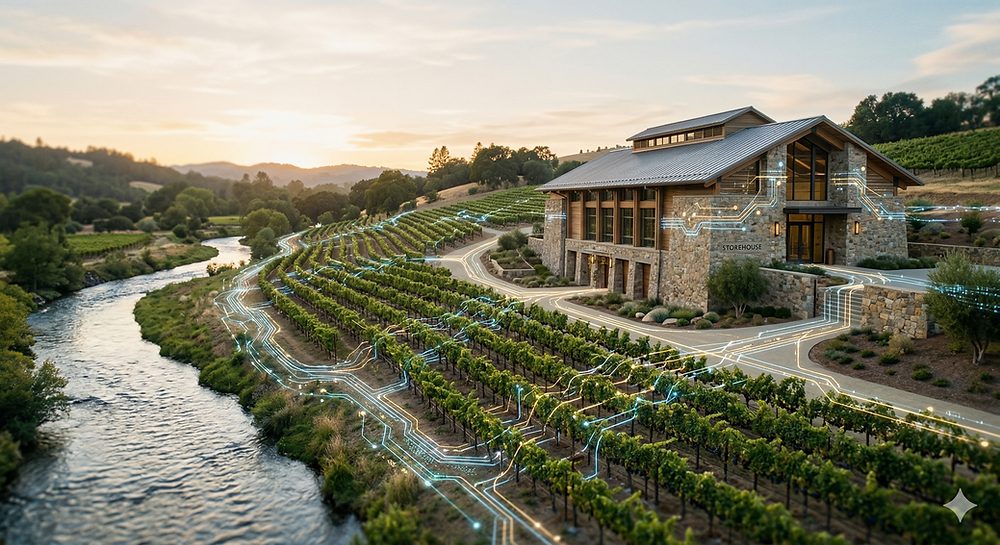
The River, the Vineyard, and the Storehouse · Chapter 3
When The River recedes, the Chain-Makers arrive. Why financial contractions are the most dangerous moment for a founder's sovereignty.
Below him, on the valley floor, the Jar-Carriers had stopped moving. The River had receded fifty paces from the bank, leaving a belt of deep, suffocating silt between the dry path and the dark current. Strong men were useless. Gilded jars were useless. Kael, the loudest of them, the one who had laughed longest at Elian's chiselling, had sunk to his waist in a single step and had to be hauled out with ropes.
Then the Chain-Makers arrived.
They rode in from the Lowlands wearing white silk robes that didn't seem to feel the heat. Their leader, Malakor, had a voice like oil on water. "Do not fear the mud. Our pipes can reach the deep water. Sign this small parchment. A portion of your future harvest, just a fraction, to pay for the iron that saves you."
Elian watched the Jar-Carriers reach for the iron collars. He watched them sign.
"They are selling them their own lives," he said.
"They are selling them Borrowed Streams," Silas replied. "The Chain-Makers know that when a man is thirsty, he will trade his sovereignty for a sip."
The Ghost That Makes the Now Look Like the Forever
The Ghost of the Drought is not the drought itself. It is the psychological distortion the drought creates, the conviction that a temporary contraction is permanent, that a receding tide is a vanishing River. When that ghost takes hold, rational people make permanent decisions in response to temporary conditions.
The Jar-Carriers were not weak men. They were experienced, capable, and hardworking. But their entire system was built on surface access. When the surface changed, they had nothing beneath it to stand on. There was no depth in their model, so when conditions shifted, they had no options except the ones Malakor was selling.
The founders most vulnerable in a financial drought are, counterintuitively, often the most successful ones. High revenue. High overhead. A lifestyle and an operation both calibrated to the good years. When the River recedes, when rates rise, when a market contracts, when a key client leaves, they discover that everything they built was a jar-carrying operation. The water was always there. The system to reach it wasn't.
The Borrowed Stream and the Iron Hook
Malakor's offer was not fraudulent. The pipes were real. The water was real. The fraction was the problem.
A HELOC drawn against a Vineyard that hasn't been properly structured is a Borrowed Stream. A high-interest credit facility used to bridge a lifestyle gap during a revenue plateau is a Borrowed Stream. Margin lending against a portfolio not governed by a Sovereignty Charter™ is a Borrowed Stream.
The iron hook in each case is the same: the interest doesn't care whether your River is flowing or not. It compounds whether the season is good or bad, whether the business is growing or contracting, whether you feel solvent or not. The Chain-Makers designed it that way. They thrive in droughts precisely because they know that a man who built his life on surface access has no other options when the surface disappears.
Digging Deeper: What the Drought Reveals
Elian knelt and looked into the groove he had cut into the granite. Even in the drought, a faint cool dampness was seeping through the pores of the rock at the bottom of the trench. The River was deep. It moved through the veins of the earth long before it touched the surface.
"Your stone path is not just a ditch. It is an invitation. The drought is not the end of the water. It is the end of the easy access."
For the growth-stage founder, digging deeper during a drought looks like three moves:
1. Refine the Corporate Channel
The corporation is one part of the Vineyard, not the whole of it. During a contraction, the discipline is not to borrow against the corporation; it is to ensure the channel between the corporation and the broader Vineyard is clear and governed. Profit that pools in an unstructured operating company is not wealth, it is water in the wrong place.
2. Optimise the Tax Architecture
A drought is not the time to shelter income less aggressively. It is the time to ensure the holding company, investment account, and salary/dividend split are performing their function precisely when the pressure is highest. The Sovereignty Operating System™ governs this in the bad seasons, not just the good ones.
3. Protect Non-Correlated Assets
The Inner River is the part of the Vineyard the surface drought cannot evaporate. The Sovereignty Charter™ defines which assets are Storehouse assets and which are Vineyard assets, before the drought arrives, not during it.
The Steward's Three Rules for the Drought
1. Do Not Sign Anything in the First Thirty Days
The Ghost of the Drought is most powerful in the first month of a contraction, when fear is freshest and Malakor's pipe looks most reasonable. The Sovereignty Charter™ exists precisely to govern this window, defining the Decision Threshold above which no commitment is made without review.
2. Diagnose Before You Deploy
Before any capital moves, the question is not "where should I put this?" but "what does my system actually look like right now?" Most founders discover, in this audit, that the drought has not damaged the deep assets. It has only disrupted the surface flow.
3. Build When Others Borrow
The Jar-Carriers were buying pipes while Elian was cutting stone. The drought is when the cost of building depth is lowest, because labour is available, competition is distracted, and the Chain-Makers have occupied everyone else's attention. The founder who uses a contraction to govern his Vineyard more precisely emerges from it with a deeper architecture than the one who entered.
Are You in the Drought Right Now?
This is not a failure. It is a diagnosis. The Inner River can still be found, but it requires a planner who can show you exactly where to dig.
Frequently Asked Questions
What is the Ghost of the Drought in financial planning?
The Ghost of the Drought is the psychological distortion that makes a temporary financial contraction feel permanent. It causes founders and high-earners to make reactive decisions, borrowing against future sovereignty or signing predatory agreements, in response to conditions that will change. The antidote is a governance structure like the Sovereignty Charter™ that defines the rules of capital management before the pressure arrives.
What are Borrowed Streams in Canadian finance?
Borrowed Streams are financial instruments used to bridge a lifestyle or operational gap during a downturn, HELOCs, high-interest credit lines, and margin lending that carry ongoing interest regardless of the borrower's revenue cycle. They become destructive when used to maintain a surface-access lifestyle that should instead be restructured.
How do I protect my wealth during a recession in Canada?
Protection during a contraction depends on what was built before it. Founders who weather downturns with the least damage are those whose Vineyard is governed by a Sovereignty Charter™ that specifies which assets are protected, which are growth-oriented, and what the decision rules are before conditions force the question.
What is the difference between a Jar-Carrier and a Steward in a downturn?
A Jar-Carrier's system depends on surface access, income, liquidity, and stability all require continuous manual effort. When conditions shift, they have no depth to fall back on. A Steward has built architecture beneath the surface, governed structures, non-correlated assets, and a Sovereignty Charter™ that protects capital regardless of what the surface is doing.
When is the right time to build financial governance?
Before the drought. The Sovereignty Charter™ is most valuable when built before pressure arrives. But even a charter built in the first week of a contraction is worth more than no charter at all. The worst time to govern capital is after the Borrowed Stream has already been signed.
Ready to talk about your own situation?
Talk It Through